 ultimate-guide
Save Money on Family Groceries: A 2026 Guide
Table of Contents
- Why Family Grocery Bills Keep Climbing
- Build a Family Grocery Budget That Actually Fits
- Plan a Weekly Meal Plan on a Budget
- Turn Your Meal Plan Into a Cheap Grocery List for a Family
- Compare Unit Prices and Promotions Fairly
- Shop Smarter: Deals, Store Brands, and Bulk Buying
- How to Reduce Food Waste Without Spending More
- Track Your Savings and Keep the System Running
- Frequently Asked Questions
Last Updated: October 18, 2026
Why Family Grocery Bills Keep Climbing
Buying family groceries has never been a passive expense, and in 2026 it takes active management. The core problem is not one big splurge; it is dozens of small, invisible decisions: the extra snack thrown in the cart, the produce that wilts before Thursday, the "I'll just grab something" run that costs more than a planned dinner. Learning to save money on family groceries is less about extreme couponing and more about building a repeatable system.
Build a Family Grocery Budget That Actually Fits
A family grocery budget is a spending ceiling for food and household staples, set before you shop rather than discovered at checkout. The most common mistake is setting a number that ignores your real life: sports nights, school lunches, and the occasional pizza rescue. Start with what you currently spend for two to three weeks, then trim in stages. Many families find that separating "planned meals" from a "convenience buffer" makes the number easier to hold, because it stops one unplanned takeaway from blowing the whole week.
A Budget Method You Can Adapt to Your Own Prices
The ranges below are starting points, not targets to hit exactly.
| Household Size | Weekly Food Budget Range | Monthly Equivalent | Strategy Focus |
|---|---|---|---|
| 2 adults | $90-$130 | $390-$560 | Fewer bulk buys, smaller portions, one flex night |
| Family of 4 | $150-$220 | $650-$950 | Meal plan + store brands + one batch-cook day |
| Family of 5-6 | $200-$280 | $870-$1,210 | Bulk staples, batch cooking, lunch packing |
| Family of 7+ | $250-$340 | $1,080-$1,470 | Unit-price shopping, leftovers, pantry inventory |
The ranges scale roughly with headcount, but the biggest lever is consistency, not the exact figure. A family of four that plans five dinners and packs lunches four days a week will usually land near the middle of its range even in a higher-cost area, because the plan removes the unplanned convenience spend that pushes households to the top of the range.
Separate the Budget Into Three Buckets
A single grocery number is hard to manage because it hides three different kinds of spending. Split it: planned meals (the ingredients for your written plan), staples and restock (rice, oats, oil, coffee, household basics), and a convenience buffer (the takeout night, the school fundraiser pizza, the emergency run). Most families find the buffer is where the budget actually breaks, not the meal plan.
Set the Budget Before the Flyer, Not After
A common pattern is to build the budget after seeing the sales, which turns a spending ceiling into a spending invitation. Set the ceiling first, then build the meal plan inside it using the sale flyer as a tool, not a driver. If the flyer's best deals do not fit the ceiling, skip them. A discount on an item you did not plan to buy is not a saving; it is an unplanned purchase with a sticker that makes it feel responsible.
Review Weekly, Adjust Monthly
Track the planned amount, the actual amount, and one thing that went wrong each week. Over a month, patterns emerge: maybe the buffer is too small for your schedule, or the produce spend is high because you are buying fresh herbs you throw away. Adjust one variable at a time. The goal is a budget that survives a normal month, not a perfect month, because a ceiling you cannot hold is worse than a slightly higher one you can.
Plan a Weekly Meal Plan on a Budget
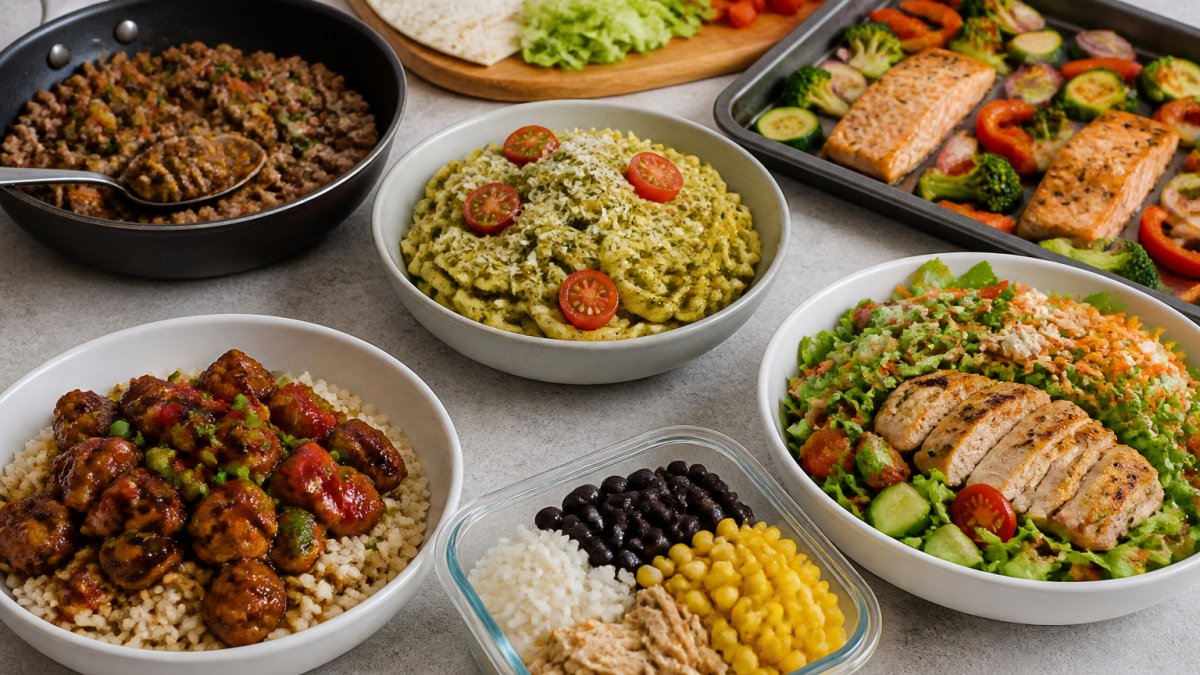
A weekly meal plan on a budget is a seven-day dinner (and lunch) outline built from ingredients you can buy cheaply and cook quickly. The trick is planning around what is already in your pantry and what is on sale, not around a Pinterest board.

A Sample Week of Budget Family Meals
- Monday: Bean and rice bowls with sautéed vegetables
- Tuesday: Baked chicken thighs with roasted potatoes
- Wednesday: Pasta with canned tomatoes and frozen spinach
Notice the pattern: cheap proteins (beans, lentils, chicken thighs), frozen and canned produce, and one night that recycles leftovers.
Turn Your Meal Plan Into a Cheap Grocery List for a Family
A cheap grocery list for a family is a categorized list that mirrors your store's layout, so you shop once and don't backtrack. The mistake most people make is writing an alphabetical list, then wandering aisle to aisle. Instead, group by department: produce, meat and fish, dairy, pantry, frozen, household. Check your pantry before adding anything, and cross off duplicates.
Compare Unit Prices and Promotions Fairly
Unit price is the cost per ounce, pound, or count, and it is the only fair way to compare two packages of different sizes. The big package is not always cheaper. Divide the total price by the number of units or weight, and compare that number. Promotions complicate this: a "buy one, get one" deal on a large box can still lose to a smaller store-brand item at a lower unit price.
Compare Cost per Serving, Not Just Cost per Pound
Cost per pound is a starting point, but it overstates the value of anything with bones, trim, or water weight. A whole chicken at a low per-pound price includes bones and skin you do not eat; boneless thighs at a higher per-pound price can cost less per serving of usable meat. The same logic applies to a bag of oranges with thick peels versus a bag of frozen fruit that is nearly all edible.
Read the Unit-Price Line, Then Do the Promotion Math
Most stores print a unit price on the shelf tag, usually in small type under the retail price. Use it as the first filter, not the final answer. For a promotion, do the math on the deal as a whole: a "buy two, save $2" offer only lowers your household spend if you would have bought both anyway. If the deal requires buying a larger quantity than you will use before it spoils, the effective cost per usable unit rises, and the promotion is a loss disguised as a discount.
A Fair Comparison Method in Four Steps
- Normalize the unit. Convert both packages to the same unit (per ounce or per pound) before comparing.
- Adjust for usable yield. If one option has bones, peels, or water weight, estimate the edible share and compare on that basis.
- Check the promotion's true unit price. Divide the deal price by the total quantity you must buy, not the quantity you plan to use.
- Tie-break on spoilage. If two options tie on adjusted unit price, choose the one your household will finish, because wasted food is the highest unit price of all.
Where Promotions Usually Help and Where They Usually Do Not
Promotions tend to help on shelf-stable items you use constantly: canned goods, rice, oats, pasta, frozen vegetables, and household basics. They tend to hurt on perishables bought in quantities larger than your household can finish, and on "spend $50, save $10" offers that push you to add items you did not plan to buy. The test is simple: would you have bought this item at this quantity without the promotion?
Shop Smarter: Deals, Store Brands, and Bulk Buying
Store-brand products and own-brand staples are where most families leave easy money on the table. They are typically made to the same basic standards as the national brands and often cost noticeably less. Bulk buying makes sense for shelf-stable items you use constantly (rice, oats, canned goods, frozen vegetables) and rarely makes sense for perishables. Shop the reduced section for meat and bakery items you can freeze or use that day.
How to Reduce Food Waste Without Spending More
Reducing food waste is a cost-cutting move, not a separate chore. The easiest system is a "use-it-first" shelf in the fridge where leftovers and aging produce live, plus a weekly five-minute fridge audit before you shop. Store produce correctly (greens wrapped, berries dry, herbs in water) and freeze what you won't finish. Canned and frozen produce are not a downgrade; they are often cheaper, last longer, and reduce the waste that erodes a grocery budget.
Track Your Savings and Keep the System Running
Track your grocery spending weekly, not monthly, so you can correct course before the month is gone. A simple notebook or a shared digital note works fine: write the planned amount, the actual amount, and one thing that went wrong. Over a few weeks, patterns emerge, and you can adjust the plan. The families who stick with this system are the ones who treat it as a habit, not a one-time challenge.
Frequently Asked Questions
How can I drastically lower my grocery bill?
Start with three moves: plan meals before you shop, build a list from that plan, and set a weekly spending cap. Then cut costs further by choosing store-brand products, comparing unit prices instead of shelf prices, and buying frozen or canned produce when it is cheaper than fresh. Families that combine meal planning with a written list tend to spend less because they buy fewer impulse items and throw away less food. Review your receipts weekly to spot where the money actually goes.
How much does an average family spend on groceries?
Spending varies widely by household size, region, and diet, so treat any single number as a starting point rather than a target. The practical approach is to track your own receipts for four weeks, average them, then set a family grocery budget about 10 percent below that figure. From there, adjust by household size: a family of four generally needs more than a couple, and teenagers eat more than toddlers. Your own four-week average is more useful than a national estimate.
Is meal planning cheaper than shopping without a plan?
In most cases, yes. A weekly meal plan on a budget tells you exactly what to buy, which cuts duplicate purchases and last-minute takeout. It also lets you build meals around what is on sale and what you already have in the pantry. The savings come from two places: fewer impulse buys at the store and less food spoiling in the fridge. Even a rough plan written in five minutes beats walking into the supermarket with no list.
How do I make a weekly grocery budget for my family?
Track four weeks of receipts to find your real average, then set a weekly cap slightly below it. Divide the cap into categories: produce, protein, dairy, pantry staples, and household items. Build your cheap grocery list for a family around that split so you know when you are overspending in one area. Keep a small buffer, around 10 percent, for sales and unexpected needs. Review the budget every month and adjust based on what actually happened.
What are the best ways to reduce food waste and grocery costs?
Plan portions so you cook what your family actually eats, store produce correctly, and schedule a leftovers night each week. Keep a visible "eat first" shelf in the fridge for items nearing their date. Freeze bread, meat, and ripe fruit before they spoil. When you know how to reduce food waste, the grocery savings follow automatically, because every thrown-out item is money you already spent. A five-minute fridge check before shopping prevents duplicate buys.
How can a family save money on groceries without sacrificing healthy meals?
Build meals around low-cost staples like beans, rice, eggs, oats, and frozen vegetables, then add protein and fresh produce where they matter most. Frozen fruit and vegetables are often cheaper than fresh and just as nutritious. Compare unit prices on store-brand versus national-brand items; the ingredients are frequently similar. A weekly meal plan on a budget makes this easier because you choose meals that share ingredients, so nothing goes to waste.
The hardest part of saving on family groceries is not knowing what to do; it is doing it every week when life gets busy. That is exactly where Saltwater Mom Life helps. Our budget-friendly, prep-focused digital meal plans include curated recipes and organized shopping lists that simplify your kitchen routine, so you can save time and money without starting from scratch each Sunday. Get started with Saltwater Mom Life and turn your grocery budget into a system that actually holds.