 how-to
Organized Grocery List for Families: A Simple Weekly System
Last Updated: October 23, 2026
Quick Summary
An organized grocery list for families groups items by store section and is built from your meal plan, not from memory. Pick five dinners, list every ingredient, cross off what you already own, then sort the list in the order you walk the store. The whole routine takes about 20 minutes on a Sunday.
- Plan for five dinners, not seven, since most families eat leftovers or order out at least twice.
- List ingredients in this order: proteins, produce, dairy, pantry staples, frozen.
- Match your list sections to your store's actual layout, since layouts are not universal.
- Convert your household to adult-equivalent servings to scale quantities correctly.
- Keep one meal for everyone and set out optional add-ons instead of cooking a separate kids' meal.
Table of Contents
- Why an Organized Grocery List for Families Saves Time and Money
- Start With a Family Meal Planner and Grocery List
- Build Your Weekly Grocery List for Family Meals
- Organize Your Grocery List by Category and Store Section
- Grab a Free Printable Grocery List Template
- Adjust Quantities for Your Household Size and Appetite
- Handle Picky Eaters, Allergies, and Dietary Swaps
- Run a Repeatable Weekly Workflow From Plan to Cart
- Frequently Asked Questions
Why an Organized Grocery List for Families Saves Time and Money
An organized grocery list for families groups what you need by store section, so you shop once, buy what you'll actually cook, and stop guessing at 5 p.m.
Here's what most guides get wrong: the list isn't the hard part, the meal plan behind it is.
What you get from doing this well:
- Fewer mid-week store runs
- Less food thrown out because it was never part of a meal
- A predictable grocery budget you can actually track
The system below takes about 20 minutes on a Sunday and pays that back all week.
Start With a Family Meal Planner and Grocery List
The right order is simple: pick your dinners, then build the list from those dinners. A family meal planner and grocery list work as one tool, not two. Most families do this backwards, buying ingredients that don't combine into meals.
Try this instead:
- Open a calendar and mark the nights you'll cook.
- Assign a meal to each night, using recipes you already know.
- Pull the ingredient list from each recipe.
- Cross off anything you already have.
- Move the rest to your grocery list.
That's the whole loop. Keep it under 20 minutes and it survives a busy week.
Build Your Weekly Grocery List for Family Meals
A weekly grocery list for family meals comes straight from your recipes, not from memory. Write down every ingredient, including the ones you think you have, this catches the small stuff that ruins a meal: the missing spice, the forgotten can of tomatoes, the last egg.
Work in this order:
- Proteins: chicken, ground meat, seafood, eggs, beans
- Produce: fresh fruit and vegetables your meals need
- Dairy: milk, cheese, yogurt, butter
Then check your fridge and pantry against the list and cross off what's already there. This quick inventory check is the single best way to cut food waste and food costs at once.
Organize Your Grocery List by Category and Store Section
Organizing your grocery list by category means matching the list to the order you walk the store: produce first, then meat and seafood, dairy and eggs, pantry staples, frozen, and snacks last.
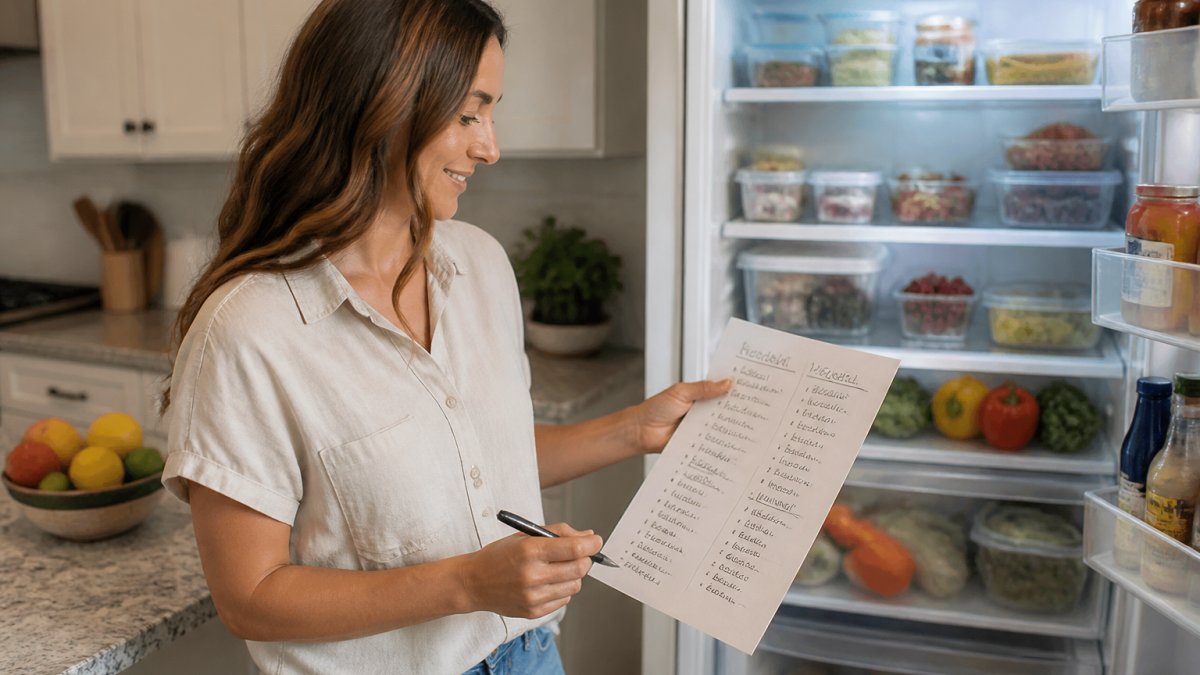
A filled-in example for a family of four
Here is a complete weekly list for two adults and two school-age kids, built from five dinners: sheet-pan chicken thighs, ground turkey tacos, pasta with marinara and sausage, salmon with roasted vegetables, and a bean-and-rice bowl night. Quantities assume moderate appetites and one leftover lunch per dinner.
| Store Section | Item | Quantity | Meal It Belongs To |
|---|---|---|---|
| Produce | Yellow onions | 3 | Tacos, pasta, bean bowl |
| Produce | Garlic | 1 head | Pasta, bean bowl |
| Produce | Bell peppers | 3 | Tacos, sheet pan |
| Produce | Broccoli crowns | 2 lb | Sheet pan, salmon night |
| Produce | Carrots | 2 lb | Salmon night, snacks |
| Produce | Apples | 6 | Snacks, lunches |
| Produce | Bananas | 1 bunch | Breakfasts, snacks |
| Produce | Lemons | 2 | Salmon night |
| Produce | Baby spinach | 1 (5 oz) tub | Bean bowl, salads |
| Meat & Seafood | Chicken thighs, bone-in | 3 lb | Sheet pan |
| Meat & Seafood | Ground turkey (93/7) | 2 lb | Tacos |
| Meat & Seafood | Italian sausage | 1 lb | Pasta |
| Meat & Seafood | Salmon fillets | 1.5 lb | Salmon night |
| Dairy & Eggs | Milk | 1 gallon | Breakfasts, cooking |
| Dairy & Eggs | Shredded cheddar | 2 (8 oz) bags | Tacos, bean bowl |
| Dairy & Eggs | Plain Greek yogurt | 1 (32 oz) tub | Tacos topping, breakfasts |
| Dairy & Eggs | Butter | 1 lb | Cooking, baking |
| Dairy & Eggs | Eggs | 18-count | Breakfasts, binder for tacos |
| Pantry Staples | Rice | 2 lb bag | Bean bowl |
| Pantry Staples | Pasta | 2 (1 lb) boxes | Pasta night |
| Pantry Staples | Canned black beans | 4 (15 oz) cans | Tacos, bean bowl |
| Pantry Staples | Canned diced tomatoes | 2 (14.5 oz) cans | Pasta, bean bowl |
| Pantry Staples | Marinara sauce | 2 (24 oz) jars | Pasta night |
| Pantry Staples | Taco seasoning | 1 packet or bulk | Tacos |
| Pantry Staples | Olive oil | 1 bottle (check level) | Multiple |
| Pantry Staples | Tortillas (flour or corn) | 2 (10-count) packs | Tacos |
| Frozen | Frozen peas | 1 (16 oz) bag | Sheet pan, pasta |
| Frozen | Frozen berries | 1 (16 oz) bag | Breakfasts, snacks |
| Snacks | Crackers | 2 boxes | Snacks, lunches |
| Snacks | Granola bars | 1 box | Lunches, snacks |
| Snacks | Fruit pouches | 1 box | Younger kids, lunches |
The blank version to reuse each week
Copy this skeleton into a notes app or print it, and fill in the item column from your meal plan. Keep the section order fixed so your brain learns the route.
| Store Section | Item | Quantity | Meal | Already Have? |
|---|---|---|---|---|
| Produce | ||||
| Meat & Seafood | ||||
| Dairy & Eggs | ||||
| Pantry Staples | ||||
| Frozen | ||||
| Snacks |
Match the list to your actual store layout
Store layouts are not universal. Produce often sits near the entrance, dairy and eggs along the back wall, and frozen on a middle aisle, but big-box stores often flip that. Walk your usual store once, note the order you pass each section, and reorder the template to match.
Grab a Free Printable Grocery List Template
A free printable grocery list template gives you the store-section layout already done, so you only fill in the blanks. Print a stack, keep them on the fridge, and the list becomes part of your routine. Paper still wins for many families, it doesn't die mid-trip, and anyone can add to it with a pen. If you prefer digital, use a shared notes app with the same section headings.
What to look for in a template:
- Sections that match your store's layout
- Space for quantities, not just item names
- A spot for "already have" so you don't double-buy
Adjust Quantities for Your Household Size and Appetite
Scale your quantities to your actual household, not the recipe's default serving count. Convert your household into "adult-equivalent servings," then multiply by a per-person baseline for each category.
Convert your household to adult-equivalent servings
Use these rough multipliers, which most home cooks find close enough for planning:
- Adult: 1.0 serving
- Teen (13-18): 1.25-1.5 servings, depending on activity level
- Child (6-12): 0.6-0.75 servings
Add the multipliers for everyone eating dinner at home. A household of two adults and two kids ages 8 and 11 lands around 1.0 + 1.0 + 0.7 + 0.7 = 3.4 adult-equivalent servings. That is the number you plan dinners around, not the recipe's stated four.
Per-person baselines by category
These are starting points for a week of five cooked dinners plus breakfasts and lunches. Adjust after two weeks of watching what actually gets eaten.
- Protein: 6-8 oz raw per adult-equivalent per dinner. A family at 3.4 adult-equivalents needs roughly 20-27 oz of raw protein per dinner, or about 6-8 lb across five dinners if each night uses a different protein.
- Starch (rice, pasta, potatoes): 2-3 oz dry per adult-equivalent per dinner. That same family needs about 7-10 oz dry per dinner.
- Vegetables: 4-6 oz per adult-equivalent per dinner, plus extra for snacks and lunches.
Adjust for appetite swings and life stage
Kids eat more during growth spurts and less when they're off their food, and teens in sports can eat close to two adult servings at dinner. Buy slack in pantry staples and frozen vegetables, not fresh produce, since those absorb a big appetite week without spoiling. Start at the lower end of each range and nudge quantities up one unit at a time.
A quick scaling example
If your taco night recipe calls for 1 lb of ground turkey to serve four, and your household is 3.4 adult-equivalents, cook it as written. At 5.0 adult-equivalents (two adults and three teens), scale to about 1.5 lb. At 2.0 adult-equivalents (one adult and one child), scale to about 0.75 lb and plan the remainder as leftovers.
The goal is enough food, not a full fridge. Overbuying fresh food is the most common budget leak we see in family grocery shopping.
Handle Picky Eaters, Allergies, and Dietary Swaps
Build the list around what your family will actually eat, then swap around the edges. Picky eaters and allergies don't have to mean cooking two dinners.
A few swaps that work:
- Allergy to dairy: use plant-based milk and cheese, and check labels on sauces
- No red meat: swap ground beef for ground turkey or lentils in the same recipes
- Picky eater at the table: serve the base meal plain and let them add sauce or toppings themselves
The trick is to keep one meal, not two. Cook a base everyone can eat, then set out optional add-ons. That protects your time and your grocery budget.
Run a Repeatable Weekly Workflow From Plan to Cart
The system works only if you repeat it on the same day each week.
Here's the workflow:
- Sunday, 15 minutes: pick five dinners from your recipe collection or a weekly meal plan.
- Next 10 minutes: list every ingredient, then cross off what you already own.
- Next 5 minutes: sort the list by store section.
- Shopping day: shop the list in aisle order, once.
- After shopping: prep what you can, wash produce, cook one protein, so weeknights run faster.
That's the loop. Skip a week and it still works next week.
If the planning itself keeps falling apart, our weekly guides at Saltwater Mom Life are designed to help.
Ready to take the planning off your plate? Get started with Saltwater Mom Life and simplify your weekly grocery run.
Frequently Asked Questions
How do you organize a grocery list for a family?
Start with your week's dinners, then list every ingredient each recipe needs. Group those items into store sections: produce, meat and seafood, dairy and eggs, pantry staples, frozen foods, and snacks. Add breakfast, lunch, and household basics. Keep the list on one page, ordered the way you walk the store, so you never double back. A grocery list by category also makes it easy to hand off a section to another shopper.
What should be on a weekly grocery list for a family?
A solid weekly grocery list for family meals covers produce (fresh fruit and vegetables plus frozen options), proteins like chicken, ground meat, and seafood, dairy including milk, eggs, and cheese, pantry staples such as rice, pasta, and canned goods, and kid-friendly snacks. Add breakfast items, lunch supplies, and any household basics running low. Build the list from your meal plan first, then fill gaps from a quick fridge and pantry check.
How do you make a grocery list from a weekly meal plan?
Write out your dinners for the week, then list the ingredients each one requires, including spices and sides. Combine duplicates so you buy one bag of onions instead of three. Check what you already own before adding anything. Sort the remaining items by store section, add breakfast, lunch, and snack staples, and note quantities for your family size. This plan-to-list habit is the core of any family meal planner and grocery list system.
How can families avoid forgetting items at the grocery store?
Keep one running list in a single place, whether paper on the fridge or a shared digital note, and add items the moment you notice they are low. Before you leave, check the fridge, freezer, and pantry against the list. Shop from the list in store-section order and cross items off as you go. A free printable grocery list template on the fridge works well because everyone in the house can add to it.
For more on reducing household food waste through better planning, the USDA food loss and waste guidance is a useful reference. And if you want to build healthier meals into the plan, the USDA MyPlate meal planning resources show how to balance a plate without overcomplicating the list.