 ultimate-guide
Simple Meal Planning for Working Moms Made Easy
Last Updated: November 2, 2026
Quick Summary
Simple meal planning for working moms means choosing the week's dinners, building one shopping list, and prepping key ingredients before the week starts so no food decision is left for the end of a workday. Pick five weeknight dinners, leave two nights open for leftovers or a flex meal, and prep components in one focused block.
- Choose one day and one 30-minute block as a standing planning appointment.
- Pick five weeknight dinners and leave two nights open for leftovers or a flex meal.
- The 5 4 3 2 1 rule fills a cart with 5 dinners, 4 proteins, 3 vegetables, 2 starches, and 1 flavor base.
- A single 90-minute prep block can produce rice, shredded chicken, roasted vegetables, and a jar of sauce.
- Keep three low-energy backups stocked: a freezer meal, a pantry meal, and a breakfast-for-dinner kit.
Table of Contents
- Why Simple Meal Planning for Working Moms Beats Deciding at 6 PM
- A Beginner-Friendly Workflow for Your Weekly Meal Plan for Busy Families
- The 5 4 3 2 1 Grocery Rule as a Shortcut to a Full Cart
- Meal Prep for Busy Moms Without Losing the Whole Weekend
- Make-Ahead Meals for the Week That Survive a Schedule Change
- Budget, Picky Eaters, and Food Storage: The Parts Most Plans Skip
- Start Your First Week With a Prep-Focused Plan
- Frequently Asked Questions
Why Simple Meal Planning for Working Moms Beats Deciding at 6 PM
Simple meal planning for working moms is the practice of choosing the week's dinners, building one shopping list, and prepping key ingredients before the week starts, so no one has to make a food decision at the end of a workday.
Picture a Tuesday: you close the laptop at 5:40, pick up the kids, walk in, and someone asks what's for dinner. Nothing's defrosted or decided, so you order out while Sunday's groceries age in the crisper.
That's not a discipline problem. It's a timing problem.
The Real Cost of Decision Fatigue on a Busy Week
Decision fatigue is the mental drain that builds as you make choices all day, and it hits hardest when dinner needs to happen. By evening, the person who negotiated a deadline and a toddler meltdown must weigh five dinner options with a hungry family watching.
The cost shows up in three places:
- Money: last-minute takeout and thrown-out produce both drain the food budget.
- Nutrition: rushed meals default to whatever is fastest, not what's balanced.
- Stress: the daily "what's for dinner" loop follows you into the evening.
A weekly routine removes the decision, not the cooking, which is why the workflow below decides once and executes all week.
A Beginner-Friendly Workflow for Your Weekly Meal Plan for Busy Families
Beginner meal planning works best as a short, repeatable workflow: pick a planning time, choose dinners first, build the list from those dinners, and prep once. The process is designed to be short, and many families find it gets quicker with practice.
Here's the complete process, step by step. For a fuller step-by-step guide to meal planning, go deeper.
Step 1: Pick Your Planning Day and Time Block
Choose one day and one 30-minute block and treat it as a standing appointment. Sunday evening works for many families, and Thursday night can work just as well if that's when your week actually resets.
Two rules make this stick:
- Plan when you have energy, not when you're depleted. A tired planner picks the same five meals on rotation.
- Keep the block short. Thirty minutes forces decisions instead of endless browsing.
A common mistake is planning on the day you shop. Separate them by a day if you can, so the list has time to settle.
Step 2: Choose Dinners Before You Shop
Pick five weeknight dinners and leave two nights open for leftovers or a flex meal. Five is enough structure without pretending your week is predictable.
Choose in this order:
- Meals that reuse the same ingredients (taco night and burrito bowls share almost everything)
- Meals with overlapping cook methods so prep day stays efficient
- At least one 15-minute meal for the night that goes sideways
If you're short on ideas, our collection of fast dinner ideas for families is a good place to pull five quick weeknight meals without scrolling for an hour.
Step 3: Build the Shopping List From the Plan
Write the list by recipe, then consolidate. If three dinners use onions, you need onions once, in the right quantity.
Organizing the list by store section, rather than by recipe, can make shopping more efficient. For a simple weekly system to follow, see this organized grocery list for families.
Organized shopping lists are a feature of Saltwater Mom Life's meal plans.
The 5 4 3 2 1 Grocery Rule as a Shortcut to a Full Cart
The 5 4 3 2 1 grocery rule is a structured shopping framework that fills a cart with a set number of items from each category, so a week of meals comes together without a recipe-by-recipe list.
Here's how the counts break down:
| Category | Count | What It Covers |
|---|---|---|
| Dinners planned | 5 | Five weeknight meals, two flex nights |
| Proteins | 4 | Chicken, ground meat, eggs, beans, or fish |
| Vegetables | 3 | Fresh, frozen, or both, chosen to overlap |
| Starches | 2 | Rice, pasta, potatoes, or tortillas |
| Sauce or flavor base | 1 | One sauce, seasoning blend, or marinade used across meals |
The rule works because it forces overlap: four proteins and three vegetables can cover five dinners if you plan meals around them, and that overlap makes prep day fast. It also keeps the cart honest, if an item doesn't fit a category, it probably isn't dinner this week.
What a Real 5 4 3 2 1 Cart Looks Like
Here is a concrete example cart that feeds a family of four five dinners plus two flex nights, using only items that appear in more than one meal:
- 5 dinners: taco night, chicken-and-rice bowls, pasta with sausage and vegetables, egg-and-vegetable fried rice, and sheet-pan chicken with roasted vegetables.
- 4 proteins: boneless chicken thighs (bowls and sheet pan), ground turkey (tacos), Italian sausage (pasta), and eggs (fried rice and a backup breakfast-for-dinner).
- 3 vegetables: bell peppers (tacos, sheet pan, fried rice), onions (tacos, pasta, fried rice), and frozen mixed vegetables (fried rice, sheet pan, pasta).
That cart isn't a meal plan in disguise, it's a shopping list that makes five dinners possible because every protein and vegetable shows up at least twice.
Why the Rule Also Cuts the Grocery Bill
The 5 4 3 2 1 structure reduces food waste for a simple reason: every item has a named destination before it enters the cart.
Some families find the weekly cart gets smaller, because duplicate buys can be avoided when items have a planned use.
Watch out: the rule breaks down if you treat the counts as a checklist to fill rather than a constraint to plan around.
Adapting the Counts to Your Family
The 5 4 3 2 1 numbers are a starting template, not a law. Three adjustments cover most households:
- Smaller household (one or two people): drop to 3 3 2 1 1 and lean on the freezer for portioned leftovers.
- Picky eaters: keep the counts but choose a flavor base the whole family accepts, and serve the sauce on the side so one dinner can split into a plain version and a seasoned version.
- Tighter budget: swap one fresh protein for eggs or beans, which are typically the lowest-cost proteins per serving and still fit the four-protein count.
The point is to make the cart self-consistent before you leave the house. Once the counts fit together, the week's dinners assemble themselves.
Meal Prep for Busy Moms Without Losing the Whole Weekend
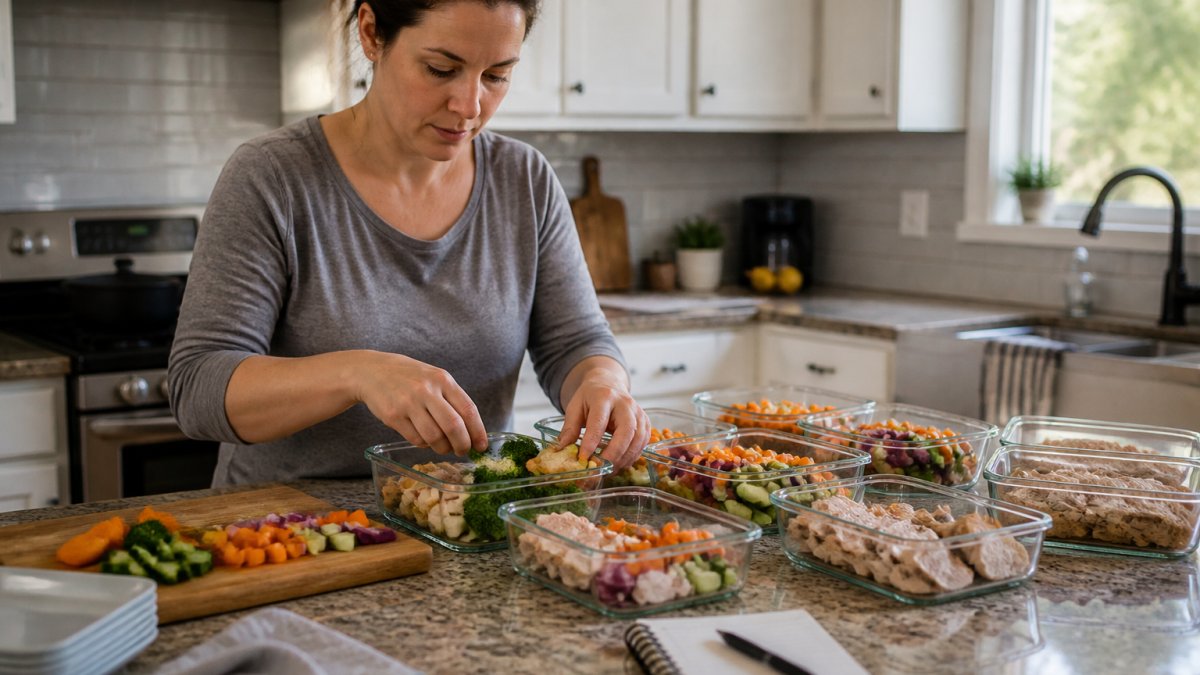
Meal prep for busy moms should take one focused block, not an entire weekend.
Ingredient Prep vs. Full Batch Cooking
Ingredient prep means washing, chopping, and portioning raw components so cooking is faster later. Full batch cooking means cooking complete meals in advance and reheating them.
Many working parents find ingredient prep, with a little batch cooking mixed in, a practical starting point. Here's the practical split:
- Prep raw: chop vegetables, marinate proteins, wash and dry greens
- Batch cook: one or two proteins, one grain, one sauce
- Leave fresh: anything that turns soggy or sad when pre-cut
Prepped ingredients can become tacos, a stir-fry, or a bowl depending on the week.
Watch out: prepping everything on Sunday with no flex night built in is the fastest route to Wednesday pizza.
Make-Ahead Meals for the Week That Survive a Schedule Change
Make-ahead meals for the week work best when they're modular: a base, a protein, and a sauce stored separately and combined at dinner. Modular meals bend when the schedule changes, a rigid day-by-day grid doesn't survive a Tuesday overtime call.
The Three-Component Build
A modular week is built from three interchangeable layers: flexible meal plans that bend when the schedule changes.
- Bases: cooked rice, pasta, tortillas, roasted potatoes, or a grain bowl base.
- Proteins: shredded chicken, browned ground turkey or beef, beans, hard-boiled eggs, or baked tofu.
- Sauces and flavor bases: salsa, pesto, a yogurt sauce, a stir-fry sauce, or a simple vinaigrette.
Prep one or two items from each layer on your prep day, store them separately, and combine at dinner. The same shredded chicken becomes tacos on Monday, a rice bowl on Wednesday, and a soup add-in on Friday.
One Prep Block, Three Different Dinners
Here is the concrete version of that promise. A single 90-minute prep block produces:
- A pot of rice, half into containers for bowls, half left for fried rice later in the week.
- Shredded chicken, poached or baked, shredded, and refrigerated plain so it takes on whatever sauce the night calls for.
- A tray of roasted vegetables, peppers, onions, and whatever's in the drawer, roasted once and used three ways.
- A jar of sauce, one sauce, not three, chosen to work with the proteins you bought.
These components can be combined into several different dinners, such as taco night, a rice bowl night, or fried rice, depending on what you have prepped.
Backup Meals for the Nights the Plan Falls Apart
The modular system is also the backup plan. When a meeting runs late or a child gets sick, you don't need a separate emergency menu, you need components that can be eaten as they are or assembled in five minutes.
Keep three low-energy options stocked at all times:
- A freezer meal: one batch of soup, chili, or a casserole frozen in a family-sized portion, labeled with the date.
- A pantry meal: pasta, a jar of sauce, and a can of beans or tuna, all shelf-stable and requiring no planning.
- A breakfast-for-dinner kit: eggs, bread or tortillas, and cheese, which most households already have on hand.
A useful backup meal is one that requires few decisions. If you have to think about what to make, it is not a backup, it is another planning task.
Swaps When the Schedule Changes Mid-Week
A modular plan survives schedule changes because components aren't locked to a day. If Tuesday's taco night becomes Thursday's, the chicken and peppers don't care.
Watch out: modular meals can become less useful when the sauce is the only thing tying the week together. If the sauce runs out or the family rejects it, the components become plain rice and plain chicken.
Budget, Picky Eaters, and Food Storage: The Parts Most Plans Skip
The parts most meal plans skip are the ones that decide whether the system survives: cost, selective eaters, and safe storage. Address all three before week one and the routine holds.
Cutting Grocery Waste Without Cutting Flavor
Food waste is where food budgets quietly leak. The fix isn't buying less, it's buying with a plan for every item.
Three habits that help:
- Buy proteins on sale and freeze in meal-sized portions
- Plan a "use it up" dinner each week for whatever is closest to turning
- Keep a running list of what's in the freezer so nothing becomes a mystery package
Planning ahead can help reduce duplicate buys and impulse additions, but whether savings outweigh any subscription cost depends on your current waste, so track one month before and after to see the difference for your household. See whether budget-friendly family meal plans actually save money.
For picky eaters, the reliable move is a "deconstructed" version of the family meal: serve the components separately and let each child build their own plate. One dinner, no short-order cooking.
Food Safety and Storage Basics for Prepped Meals
Prepped food is only a time-saver if it's still safe to eat when you get to it. Follow the USDA food safety guidance on leftovers and storage times for how long cooked foods keep, and label every container with the date it was prepped.
The short version: cool cooked food promptly, refrigerate in shallow containers, and reheat thoroughly. When in doubt about an item's age, throw it out. The FDA guidance on refrigerated storage covers the temperature ranges that matter.
Start Your First Week With a Prep-Focused Plan
The difference between a meal plan that lasts and one that dies by Wednesday is prep. Decide once, prep the components, and let the week assemble itself.
Saltwater Mom Life provides budget-friendly, prep-focused digital meal plans with curated recipes and organized shopping lists to simplify your kitchen routine.
Frequently Asked Questions
How do working moms plan meals for the week without spending hours on it?
Keep the planning session to 20 to 30 minutes on one fixed day. Pick five weeknight dinners from a short list of family favorites, write the shopping list straight from those recipes, and shop once. Simple meal planning for working moms works best when the plan is small and repeatable rather than a new set of recipes every week. Some families rotate a small set of plans and swap a meal or two each cycle.
What is the 5 4 3 2 1 grocery rule?
The 5 4 3 2 1 grocery rule is a shorthand for building a balanced cart: 5 vegetables or fruits, 4 proteins, 3 starches or grains, 2 sauces or dairy items, and 1 treat or extra. It gives you a fast structure for a weekly meal plan for busy families without weighing every purchase. Adjust the counts to your household size, and use it as a starting checklist rather than a strict formula.
What can I meal prep that will last 5 days?
Cooked proteins like chicken, ground turkey, and hard-boiled eggs are best eaten within a few days when refrigerated. Store everything in shallow containers and follow official food safety guidance for cooling and refrigerator temperatures. For anything you want past day four, freeze it instead. Make-ahead meals for the week work best when you prep components and assemble them fresh.
How do I handle picky eaters when meal planning?
Plan a build-your-own structure for at least two dinners a week, such as taco bowls or pasta with separate toppings. Cook one base meal and set aside a plain portion before adding sauce or seasoning. Keep one familiar side on the table every night. Meal prep for busy moms can be easier when the plan includes a simple fallback option, so a refused dinner does not always turn into a takeout order.
How can I meal prep without spending the whole weekend cooking?
Prep ingredients instead of finished meals. Wash and chop vegetables, cook one pot of grains, and portion proteins into marinades, then assemble dinners during the week. A 60 to 90 minute session on Sunday covers most of the week for a family of four. Cook once and serve leftovers on your busiest night, which is usually the day with the tightest work schedule.
What happens when the week falls apart and I don't follow the plan?
Build flexibility into the plan from the start. Choose five dinners for a seven-night week, leaving two open slots for leftovers or a quick backup meal. Keep one freezer meal and one pantry dinner on hand so a chaotic Tuesday does not become a pizza order. A weekly meal plan for busy families should absorb a bad day, not collapse because of one.
Your first week is the hardest, and it's also the proof. Pick a planning day, run the workflow once, and see how much calmer 6 PM feels. Get started with Saltwater Mom Life and turn one planning block into a week of easier dinners.